
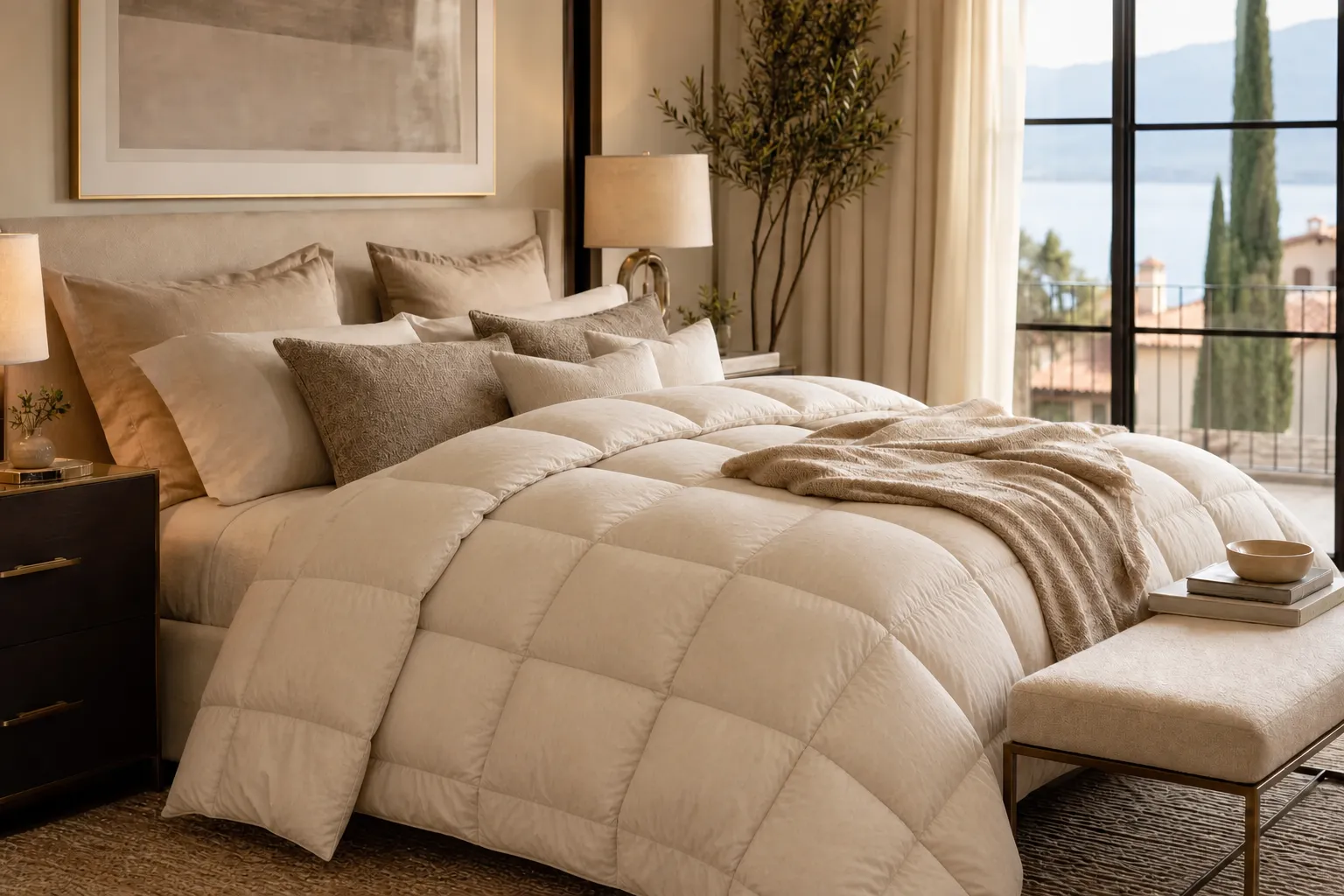
A king bed makes bad comforter choices obvious fast. Too small and you lose coverage on the sides. Too warm and one partner ends up kicking off the covers by midnight. Too flat and even a well-made bed looks underdressed. Getting a king-size goose down comforter right comes down to four things: fill type, size, warmth level, and shell fabric — in that order.
What’s Actually Inside a Goose Down Comforter
Down is the soft under-plumage beneath a goose’s outer feathers — no quills, which is why it feels airy rather than dense. Feathers, by contrast, are flatter and include a quill, so they add weight and a firmer feel. Most comforters marketed as “goose down” use a blend, with the ratio of down to feather determining how the finished product actually behaves.
A comforter with a higher down percentage feels lofty and light for its warmth, since down clusters trap air more efficiently than feathers do. A feather-heavier blend feels denser and holds more of that reassuring weight some sleepers prefer, often at a lower price point. Neither is objectively better — it depends on whether you want cloudlike lift or more substantial pressure on a king-size bed.
Sizing a King Comforter Correctly
Standard king mattresses run about 76 inches wide, and the comforter needs enough drape to cover both sleepers with a comfortable overhang on each side — this is where a lot of king buyers get burned by ordering something sized for a queen bed and stretched to fit. If you want that fuller, hotel-style silhouette, size up to an oversized king rather than relying on a standard king’s edges. California King bedrooms need extra attention too, since brand sizing for that dimension varies more than people expect, so it’s worth checking exact inches rather than trusting the label alone.
A dependable, well-proportioned starting point for king beds is something like the Organic Cotton Goose Down Comforter, which drapes generously without tipping into excessive bulk — a reasonable benchmark to compare other king-sized options against.
Matching Warmth Level to How You Actually Sleep
The most common mistake king buyers make is choosing based on how fluffy a comforter looks in photos rather than how it will actually feel at 2 a.m. A comforter can look dramatic and still run too warm for your bedroom, and a lighter one can still feel luxurious if the fill and shell are good quality.
For genuinely cold bedrooms or sleepers who run cold year-round, stepping up to a higher-loft, ultra-warm fill is worth it — something like the Organic Cotton Goose Down Comforter in its Ultra-Warm version is built for exactly that scenario, delivering more insulation without the stiff, overstuffed feel synthetic fills tend to have at higher warmth ratings.
Couples are the harder case on a king bed, since two people rarely run the same temperature. A moderate, all-season warmth level paired with a breathable shell tends to split the difference better than forcing one partner to compromise. If breathability and easy year-round use matter more than maximum loft, a versatile option like the Cozy365 Premium Down Comforter is a practical middle-ground pick for king beds that need to work for two different sleep preferences at once.
Why Shell Fabric Deserves Equal Attention
Even excellent fill underperforms inside the wrong shell. Cotton is the classic choice — breathable, easy to live with, and it keeps a king comforter from feeling stuffy under a duvet cover. Silk brings a smoother, more refined hand-feel and a more elegant drape, which matters more on a king bed simply because there’s more visible fabric on display. Linen adds a relaxed, slightly textured quality that pairs particularly well with warmer fills, since it prevents that overly sealed-in feeling heavier comforters can create.
Construction Details Worth Checking Before You Buy
Two king comforters can look nearly identical online and perform very differently once they’re on the bed. Baffle-box construction — internal fabric walls between the top and bottom layers — helps down loft fully and stay evenly distributed instead of shifting toward one side of a large king surface over time. Sewn-through construction is often lighter and less expensive, but it can create compressed, cooler seams where the stitching runs through the fill. Corner loops matter more on king sizes too, since they’re what keeps a large insert anchored inside a duvet cover instead of bunching in the middle.
Fill power is the other number worth checking: higher fill power generally means the down lofts more per ounce, so a comforter can deliver strong warmth without needing excessive fill weight — a genuinely useful distinction on a king bed, where excess weight is more noticeable across a larger surface area.
Buying During a Sale Without Getting a Downgrade
A discount only matters if the underlying product is still good. Before buying on sale, check fill composition and fill power, not just the price cut — a heavily discounted feather-heavy blend isn’t a better deal than a fairly priced down comforter if it doesn’t perform the way you need it to. Compare construction type and shell fabric across options, and factor in return policy and warranty coverage, since a king comforter is a bigger investment than most other bedding purchases and worth protecting.
The Bottom Line
The right king-size goose down comforter is the one that matches your room’s actual temperature, not the one that photographs the fluffiest. Prioritize fill type and warmth level for comfort, size and drape for fit, and shell fabric and construction for how well it holds up over years of regular use. Get those four right, and a king bed stops being the hardest size to shop for and becomes the easiest one to get comfortably right.